
|
1. Extract data from transactions where your entity acts as Transaction manager 2. Extract data from transactions where your entity acts as Lender |
Debt Tracking enables you to centralise all your transaction information in a single interface. Deal details, tranche characteristics, Administrative forms, dataroom, covenant control periods and results are all available at your fingertips.
Find out how to export all this information in Excel format, to meet your various reporting requirements; whether for audits, strategy meetings, business analytics, or simply to update other systems with operational data.
1. Extract data from transactions where your entity acts as Transaction manager
In the Desk, use the side navigation bar, select the Debt Tracking app and navigate to "Data export".
On the export templates page, you can:
- Create a new export template
- Manage existing templates
Two templates are provided by default: “Data extraction - Audit of covenant risk” and “Data extraction - Lender allowances”. You can modify them. A template you create is saved on this page for future use, and only you can access your templates.
How to create a new template?
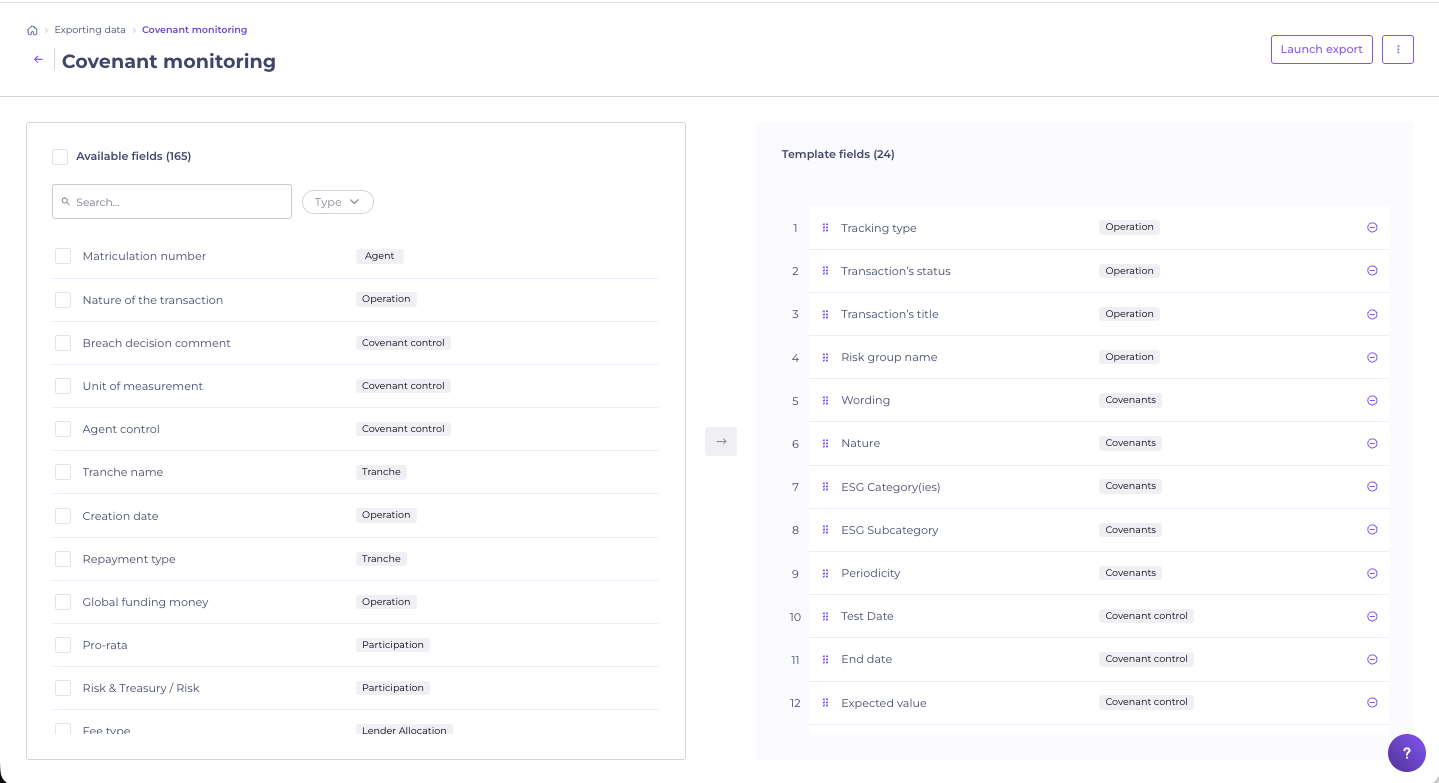
Click “Create a new template”, name it, then select the fields to export. Their order in the template determines the order of the columns in the file.
Group data that makes sense together in the same template. “Category” tags help you find fields by family.
Then, click “Launch export” in the top right-hand corner. In the window that opens, filter by transaction status if needed, choose the file format (Excel or CSV), then click “Export”.
Tick “Notify me by email when the export is ready to download” to receive a download link by email.
Data export is limited to 600,000 rows. We recommend selecting only the fields you truly require for your reporting, in order to avoid duplicate or unnecessary lines.
How to retrieve your file?
You can keep working while the file is being prepared. Then find it in the “Export history” tab to download it. It remains available for 7 days; after that, relaunch the export.
2. Extract data from transactions where your entity acts as Lender
If you participate in transactions to which you have been invited as a lender or participant, you may also extract data.
To do so, simply go to the export page and select the “Participant” view.
Then, follow the steps described in the first section above.
This feature is available exclusively for Kls clients. Not a Kls client yet? Contact us for further information.